





Which savings account will earn you the least money? Usually, a savings account with a very low APY will earn less interest than an account offering a more competitive rate. But APY isn’t the only factor to consider.
A savings account is meant to help your money grow, but not every account helps it grow at the same pace.
If the APY (Annual Percentage Yield) is very low, you will usually earn less interest than you would with a competitive high-yield savings account. But that doesn’t automatically make a low-rate account a bad choice. Fees, minimum balance requirements, and how easily you can access your money also matter.
Here’s a simple example. Suppose you have $10,000 sitting in savings. One account pays 0.10% APY, while another pays 4.00%. At first, the difference might not seem important. But over a year, the first account would earn about $10 in interest, while the second could earn about $400, assuming the rates stay the same and there are no fees.
That’s why it’s worth looking beyond the account name and checking the actual numbers before choosing where to keep your savings.
The Consumer Financial Protection Bureau (CFPB) also requires financial institutions to provide key information such as APY, interest rates, minimum-balance requirements, and fees, making it easier for consumers to compare deposit accounts.
Table of Contents
What Does “Earn the Least Money” Mean?
n this context, “earn the least money” means earning the least amount of interest from your savings.
Suppose you have $10,000 and leave it in an account for one year.
Here is a simple example:
| APY | Approximate interest on $10,000 for one year |
|---|---|
| 0.10% | $10 |
| 1.00% | $100 |
| 2.00% | $200 |
| 4.00% | $400 |
These are simplified examples where the balance stays at $10,000 and the APY stays the same for the year. Actual earnings will vary based on compounding, deposits, withdrawals and changes in the rate of the account.
APY is useful for comparisons, as it represents the annualized return on the deposit under the terms described to you by the account.
So if you have two savings accounts that have similar fees and conditions, the one with the lower APY will typically pay less interest.
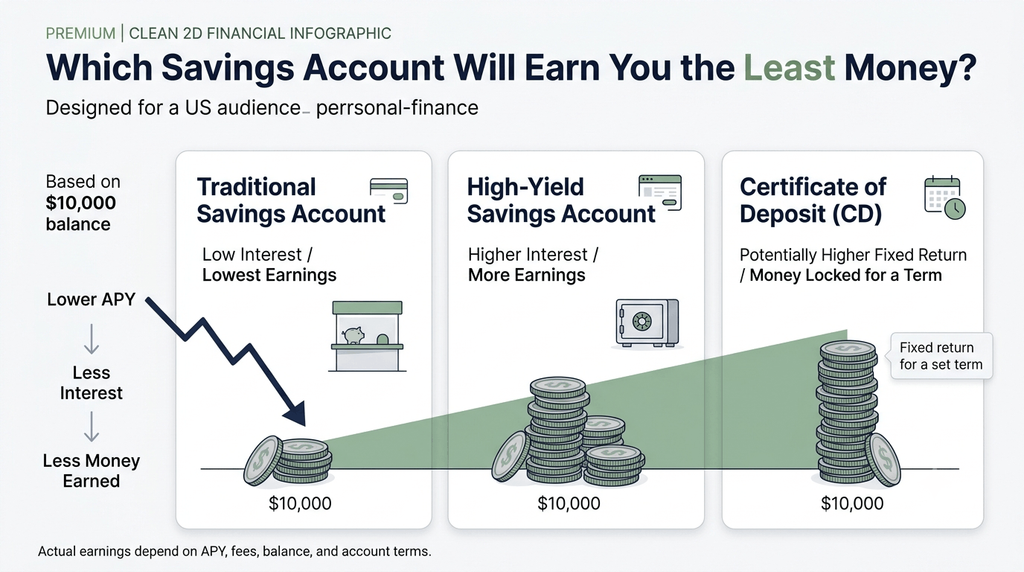
Which Savings Account Usually Earns the Least?
There is no single savings account that always pays the lowest rate.
Banks and credit unions set their own rates, and those rates can change.
However, a basic savings account with a very low APY is often one of the lower-earning options when compared with competitive high-yield savings accounts.
For example:
- Traditional savings account: 0.10% APY
- Another savings account: 1.50% APY
- High-yield savings account: 4.00% APY
If you have $20,000, the simplified annual interest would be:
0.10% APY: about $20
1.50% APY: about $300
4.00% APY: about $800
The difference between 0.10% and 4.00% is about $780 per year on a $20,000 balance in this simplified example.
That is why the APY matters more as your savings balance becomes larger.
Why Do Some Savings Accounts Pay Less?
There are several reasons one savings account may earn less than another.
1. The Account Has a Low APY
The most obvious reason is the interest rate.
For example, a bank might offer a regular savings account with a low APY and also a high APY account.
So if you deposit the same amount of money into both accounts for the same period of time, the account with the lower APY will generally earn less interest.
That doesn’t necessarily mean the account is bad.
It might also have other perks like easy access, local branches, easy transfers or a handy tie-in to your checking account.
The important thing is to understand what you are giving up in interest for those features.
Building simple saving habits can help you manage your money more effectively. Read our guide to 7 Simple Saving Money Habits That Can Make a Real Difference
2. Monthly Fees Can Reduce Your Earnings
Don’t Forget About Account Fees
Interest isn’t the only thing you need to look at when comparing savings accounts.
Some accounts charge a monthly maintenance fee if you don’t meet certain requirements, such as keeping a minimum balance. And if the fee is high enough, it can wipe out the interest you earn.
For example, suppose you have $2,000 in savings.
Your account offers:
- 1.00% APY
- About $20 in interest per year
- $5 monthly service fee
That $5 monthly fee adds up to:
$5 × 12 = $60 per year
So, in this simple example:
$20 interest − $60 in fees = −$40
You earned $20 in interest, but you paid $60 in fees. In other words, the fees were higher than what your savings earned.
The CFPB explains that banks and credit unions may charge monthly maintenance or service fees. Some institutions may waive those fees when customers meet certain requirements, such as maintaining a minimum balance.
That’s why it’s a good idea to check the fees and requirements, not just the APY, before opening a savings account.Y.
3. Minimum Balance Requirements Matter
Some have minimum balance requirements.
A bank, for example, might require a minimum balance of $1,000 in the account to waive a monthly fee.
Suppose you have $1,200 saved.
If you get an unexpected bill and your balance drops to $700, you could lose the fee waiver, depending on the terms of the account.
That means there are two ways your savings could be affected:
Your balance is smaller so you earn less interest.
You may also be charged a fee.
Before opening an account, find out the minimum balance requirements and what happens if your balance drops below these.
Traditional Savings vs. High-Yield Savings
AA high-yield savings account can offer a much better interest rate than a low-rate traditional savings account. But how much difference can that actually make?
Let’s look at a simple example.
Suppose you have $25,000 in savings.
Account A: Low-Interest Savings Account
APY: 0.10%
Estimated interest for one year:
$25,000 × 0.001 = $25
So, you would earn about $25 in interest over a year, assuming the rate and balance stay the same.
Account B: High-Yield Savings Account
APY: 4.00%
Estimated interest for one year:
$25,000 × 0.04 = $1,000
In this example, the difference would be:
$1,000 − $25 = $975
That’s a difference of about $975 in one year.
These are only examples, not rates offered by any specific bank. Savings rates can change, and the amount you actually earn depends on your balance, the account’s terms, and how the interest is calculated.
Still, this simple example shows why checking the APY can be worthwhile, especially when you’re keeping a larger amount of money in savings.
Is the Lowest-Paying Savings Account Always Bad?
Not necessarily.
A lower-interest savings account can still be useful, depending on what you need from your bank.
For example, suppose your checking and savings accounts are with the same bank. You can move money between them quickly, visit a nearby branch if you need help, and manage both accounts through the same app.
For you, that convenience might be worth accepting a lower APY.
Now imagine someone else has $30,000 in savings and rarely needs to access the money. That person may care much more about finding a competitive interest rate.
So, there isn’t one savings account that is automatically the best for everyone. It depends on what you want your money to do.
If your main goal is to earn as much interest as possible, a very low APY may not be attractive.
But if convenience, easy access, and simple banking are more important to you, a lower-rate savings account can still make sense.
What About Money Market Accounts?
What About Money Market Accounts?
A money market deposit account is another option if you’re looking for a place to keep your savings. It works differently from a regular savings account, and the interest rate can vary depending on the bank or credit union.
Some money market accounts may offer a higher APY than a basic savings account. However, they may also come with higher minimum balance requirements or other account conditions.
Here’s a simple example.
Suppose you have $10,000 to save.
Regular Savings Account
APY: 0.50%
You would earn roughly:
$10,000 × 0.005 = $50
Money Market Account
APY: 2.50%
You would earn roughly:
$10,000 × 0.025 = $250
So, in this example, the difference is:
$250 − $50 = $200
That means the money market account would earn about $200 more in one year, assuming the balance and APYs stay the same.
But don’t assume that every money market account will always pay more than every savings account. Rates change, and account requirements can be very different from one financial institution to another.
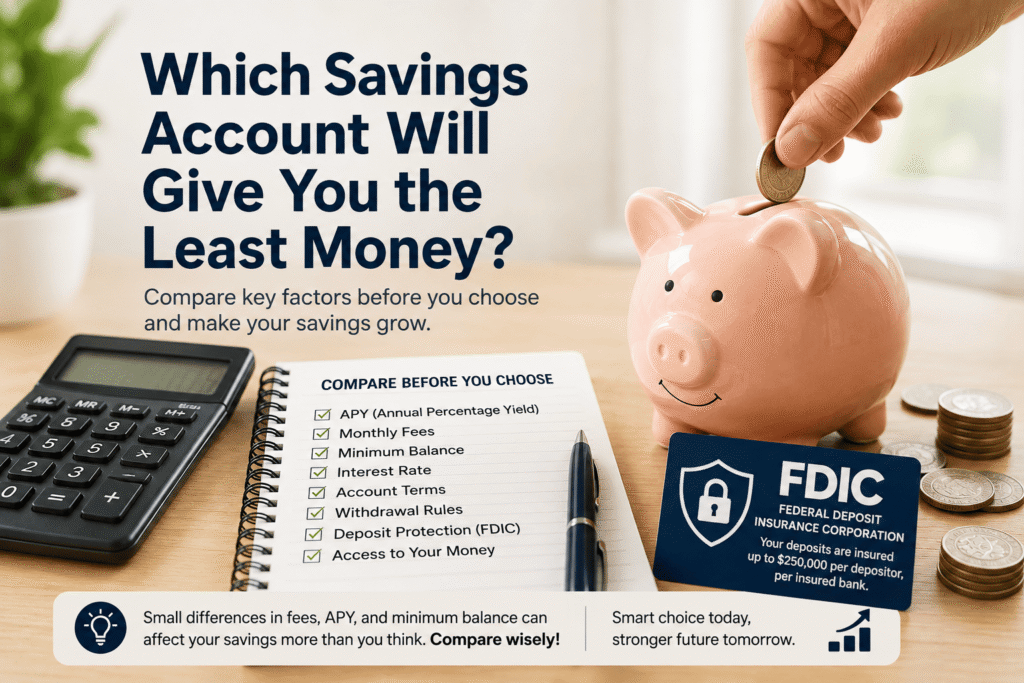
Before opening an account, take a few minutes to compare the APY, minimum balance, fees, and withdrawal or transaction rules.
Money market deposit accounts can also qualify for FDIC insurance when offered by an FDIC-insured bank, subject to applicable coverage limits. You can check the account details and the bank’s insurance status before making a decision.
The Consumer Financial Protection Bureau (CFPB) requires deposit institutions to provide disclosures that help consumers compare deposit accounts, including information about interest rates, APY, minimum-balance requirements and fees.
What About Certificates of Deposit?
A certificate of deposit, or CD, is different from a regular savings account.
With a CD, you generally agree to leave your money deposited for a specific period.
For example:
- Deposit: $10,000
- Example APY: 4.50%
- Term: 12 months
A simplified calculation would be approximately:
$10,000 × 4.50% = $450
That could be more interest than a low-rate savings account.
However, a CD may charge an early-withdrawal penalty if you take your money out before the maturity date, depending on its terms.
So you should not choose a CD simply because the APY is higher.
If the money is part of your emergency fund, easy access may be more important.
Deposit protection: FDIC insurance can protect eligible deposits at FDIC-insured banks, subject to applicable coverage limits.
Example: Which Account Should You Choose?
Imagine three people each have $10,000.
Sarah: Needs an emergency fund
Sarah wants immediate access to her money.
She chooses a savings account that offers a competitive APY and easy access.
Even if another product offers a slightly higher rate, flexibility is important to her.
David: Does not need the money for one year
David knows he will not need his $10,000 for a specific period.
He compares savings accounts and CDs and chooses an account based on the rate, term, and withdrawal conditions.
Mike: Keeps money in a low-rate account
Mike keeps $10,000 in a savings account earning 0.10% APY because it is convenient.
His approximate annual interest is only:
$10
If he could earn 4.00% APY elsewhere under suitable terms, the simplified annual interest would be:
$400
The difference would be:
$390 per year
This does not automatically mean Mike should move his money. He should first compare the complete account terms, fees, access, and insurance.
But it shows why ignoring the APY can have a real cost.
How to Find a Savings Account That Will Earn More
If your goal is to earn more interest while keeping your money in a savings account, compare these factors.
1. Compare APYs
APY should be one of the first numbers you check.
Do not compare accounts based only on the name of the bank or account.
2. Check Monthly Fees
Find out whether the account has a monthly maintenance fee.
A fee can reduce or even eliminate the interest you earn.
3. Check Minimum Balance Requirements
Find out whether you need to maintain a certain balance to earn the advertised APY or avoid fees.
4. Check Rate Conditions
Some accounts may have different rates for different balance tiers or may require certain conditions.
Read the account disclosure before opening it.
5. Check Withdrawal and Transfer Rules
Savings accounts can have account-specific rules or fees related to withdrawals and transfers.
The CFPB notes that banks and credit unions can charge fees for certain savings-account transactions or for going below a required minimum balance, depending on the account terms.
6. Check Deposit Insurance
If you are keeping a large amount of cash in a U.S. bank, verify that the bank is FDIC-insured.
FDIC insurance generally covers eligible deposit accounts at insured banks up to applicable limits. The standard coverage amount is $250,000 per depositor, per insured bank, for each ownership category.
What Is the Worst Savings Account for Earning Interest?
There is no universal “worst” savings account.
But if your only goal is earning interest, a savings account with:
- a very low APY,
- high monthly fees,
- a high minimum balance requirement,
- and restrictive conditions
could be less attractive than another account with a higher APY and lower fees.
For example, suppose two accounts both hold $10,000.
Account A
APY: 0.10%
Annual fee: $0
Approximate interest: $10
Account B
APY: 4.00%
Annual fee: $0
Approximate interest: $400
In this simplified example, Account A earns $390 less during the year.
Now imagine Account A also charges a $5 monthly fee.
The yearly fee would be $60.
The account’s simplified net result would become:
$10 − $60 = −$50
That is why APY and fees should be considered together.
Frequently Asked Questions
Which savings account earns the least interest?
Generally, a savings account with a very low APY will earn the least interest compared with accounts offering higher APYs, assuming similar balances and fees.
Is a traditional savings account a bad choice?
Not necessarily. A traditional savings account can be useful for convenience, accessibility, and keeping money separate from everyday spending. The key is to compare its APY and fees with other available options.
Can fees make a savings account less profitable?
Yes. Monthly maintenance fees, minimum-balance fees, or certain transaction fees can reduce the interest you earn.
Is a high-yield savings account always better?
Not automatically. Compare the APY, fees, minimum balance, access rules, and other conditions. A higher APY is attractive, but the complete account terms matter.
Should I keep my emergency fund in a savings account?
A savings account can be useful for emergency savings because it can keep money separate from everyday spending while allowing relatively easy access. The right account depends on your needs and its specific terms.
Can I lose money in a savings account?
Your balance can be reduced by fees or withdrawals. With an FDIC-insured bank, eligible deposits are protected up to applicable FDIC limits if the bank fails. FDIC insurance does not cover investments such as stocks, bonds, mutual funds, or crypto assets.
Final Takeaway
So, which savings account will give you the least money?
In most cases, it will be an account with a very low APY, especially when compared with another savings account offering a more competitive rate.
But APY isn’t the only thing you should look at.
Before choosing a savings account, take a quick look at:
- APY
- Monthly fees
- Minimum balance requirements
- Rate terms and conditions
- Withdrawal and transfer rules
- Deposit protection
- How easily you can access your money
A small difference in interest might not seem like much when you have $500 saved. But once your balance grows to $10,000, $25,000, or even $50,000, that difference can become much more noticeable.
The goal isn’t simply to find the account with the highest advertised rate. Instead, look for an account that gives you a competitive return, reasonable fees, easy access to your money, and the protection you need.
Taking a few minutes to compare the details before opening an account can help you make a better decision about where to keep your savings goals.
Pingback: How to Save Money Every Month: 10 Simple Ways That Work - TheMoneyHabits