





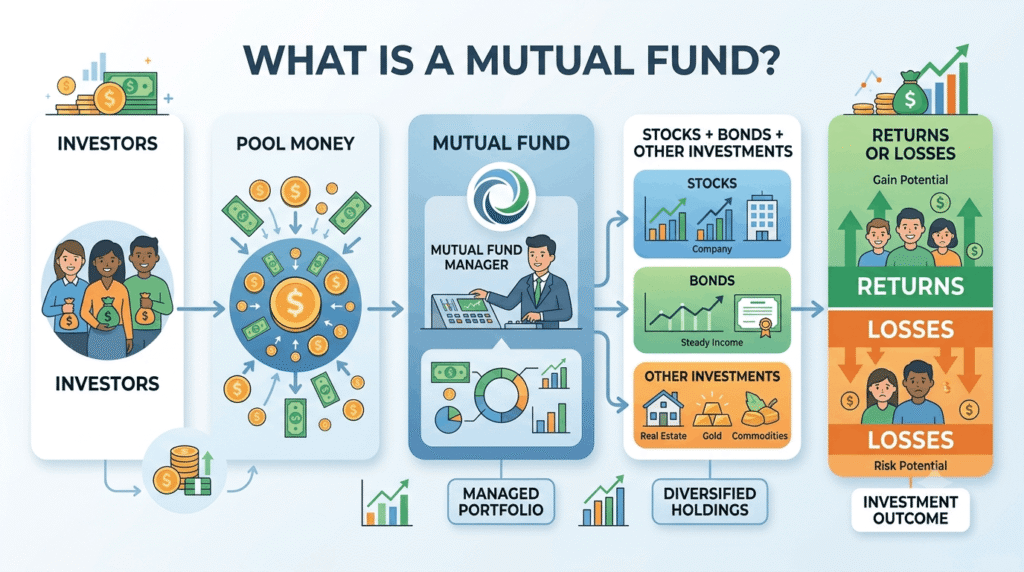
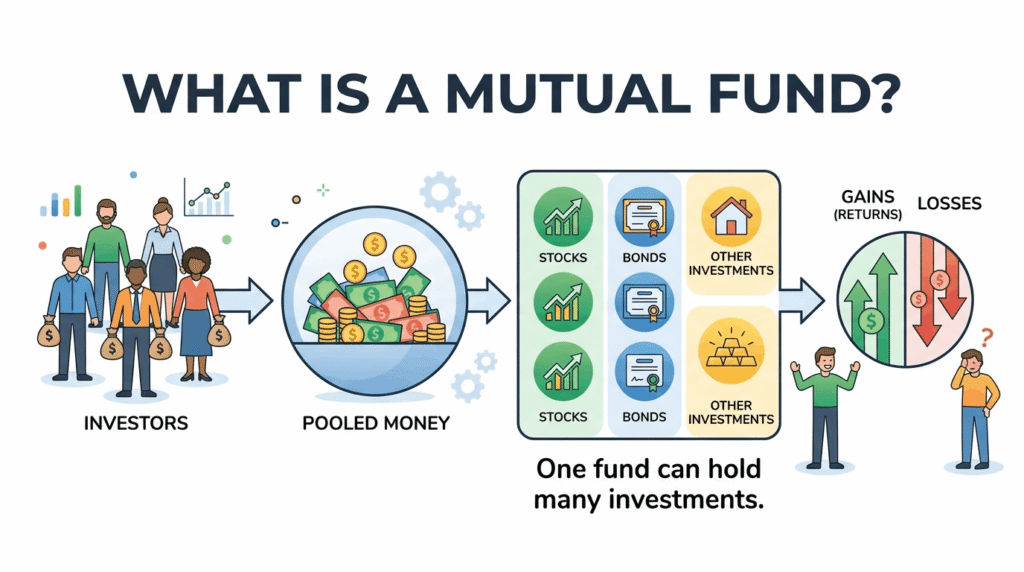
What is a mutual fund? It’s an easy way to invest in a basket of stocks, bonds, or other investments without having to pick each one yourself. A mutual fund collects money from many investors and uses that money to buy different investments. In return, investors own shares of the fund and share in its gains or losses as the value of those investments changes.
How Does a Mutual Fund Work?
A mutual fund takes the money of many investors and pools it together to buy a range of investments, such as stocks or bonds. The portfolio is usually managed by a professional fund manager in accordance with the fund’s investment strategy. The value of the mutual fund goes up or down as the investments inside the fund go up or down in value. This is an important difference from a savings account or fixed deposit. A mutual fund generally does not promise a fixed rate of interest or a guaranteed return. The actual return you receive will depend on how the investments in the fund perform.
Why Do Mutual Funds Not Give Returns Immediately?
Mutual funds are not like a savings account or a fixed deposit where you get a fixed rate of interest. They’re invested in stocks, bonds or other assets and prices can change from day to day.
These market movements may make your mutual fund investment go up or down in the short term. That’s why returns aren’t guaranteed from the get-go. Over time the value can increase, if the investments in the fund are successful.
Table of Contents
Simple example: If you invest $1000 today, it doesn’t mean you will get a fixed amount of return tomorrow. The value of your investment will depend on the performance of the fund’s underlying investments.
How Do Mutual Funds Make Money?
A mutual fund can profit when the value of stocks, bonds or other investments it owns goes up. Some investments can also produce income, for example, stocks pay dividends while bonds pay interest.
When these investments do well, the value of the mutual fund can go up. But the reverse can also happen, when the fund’s investments fall in value, the fund itself can lose value.
For this reason, you can’t get guaranteed returns from mutual funds and their returns can vary over time.
So, is profit guaranteed when you invest in a mutual fund?
No. Profit is not guaranteed when you invest in a mutual fund. The money you invest is used to buy stocks, bonds, or other investments. Since their prices can rise and fall with the market, the value of your mutual fund can also change.
If the investments perform well, your money may grow. But if the market falls, your investment value can decrease. So, mutual funds can provide returns, but those returns are not guaranteed.
How Long Should You Keep Money in a Mutual Fund?
There is no fixed time that works for every investor. How long you should stay invested depends on your financial goal and the type of mutual fund you choose.
But what happens if you need the money sooner than expected?
You can generally sell your mutual fund investment, but the amount you receive depends on the fund’s current value. If the market is down when you sell, you could receive less than what you originally invested. Some funds may also have fees or restrictions for early withdrawal.
That’s why it is important to consider your financial goal and how long you can comfortably stay invested before choosing a mutual fund.
What Is the Difference Between a Mutual Fund and an ETF?
Both mutual funds and ETFs pool money from investors and use it to buy a collection of investments. However, they work differently in some important ways.
So, are mutual funds and ETFs basically the same thing?
Not exactly. One major difference is how they are bought and sold. ETFs trade on a stock exchange throughout the trading day, while mutual funds are generally bought or sold based on the fund’s end-of-day price.
For beginners, understanding this difference can make it easier to decide which type of investment fits their needs.
Can You Lose Money in a Mutual Fund?
Yes, you can lose money in a mutual fund. Imagine you invest $1,000, and after a market drop your investment falls to $900. If you’re new to investing, it can be disconcerting to see your $1,000 turn into $900 for a period of time.
So does that mean you lost $100 forever?
Not always. So $900 is what your investment is worth now. If the market and the fund’s holdings recover, the value may go up again. But if you sell when the investment is worth $900, you would have a $100 loss before any fees or taxes.
That’s why investors in mutual funds need to be prepared for the normal ups and downs of the market, and to select investments that match their goals and risk
What Happens If You Invest $1,000 in a Mutual Fund?
When you invest $1,000 in a mutual fund, the money is invested in different assets such as stocks or bonds. The value of those investments changes over time.
So, will your $1,000 stay at exactly $1,000?
No. For example, if the investments perform well, your $1,000 might grow to $1,100. If the market falls, it could drop to $900.
Your money doesn’t simply disappear when the value falls. The $900 is the current value of your investment at that time. If the investments recover, the value can rise again. However, if you sell when it is worth $900, you would realize the loss.
Why Would I Risk Losing Money in a Mutual Fund?
That’s a fair question. Mutual funds can lose value when the market falls, but the goal is to give your money a chance to grow over time. The key is to understand the risk and invest according to your goals.
How Much Money Do I Need to Start Investing in a Mutual Fund?
You don’t always need a large amount to start. Some mutual funds allow you to begin with a relatively small investment.
How Does a Mutual Fund Make Money?
A mutual fund makes money by investing your money in assets such as stocks, bonds, or other securities. If those investments increase in value, the fund’s value can rise. Some investments may also generate dividends or interest, which can add to the fund’s returns. However, returns are not guaranteed. The value of a mutual fund can also fall when the investments it holds lose value.
What Is the Downside of Mutual Funds?
Mutual funds can make investing easier, but they also have some downsides. You may pay fees or expenses, and your investment can lose value when the market falls. Some funds may also have limits or costs when you buy or sell. The level of risk depends on what the mutual fund invests in, so it is important to understand the fund before investing.
Are Mutual Funds a Good Investment?
Mutual funds can be a good investment for people who want to invest in a range of assets without choosing every stock or bond themselves. They can provide diversification and professional management. However, they are not risk-free, and returns are not guaranteed. Whether a mutual fund is suitable depends on your goals, time frame, risk level, and the type of fund you choose.
How Long Should I Keep My Money in a Mutual Fund?
“How long should I keep my money in a mutual fund?”
There is no single time period that works for everyone. It depends on your financial goal and the type of mutual fund you choose. For long-term goals, staying invested for several years can give your money more time to grow and help you handle short-term market ups and downs.
What Are the Benefits of Mutual Funds?
Mutual funds can make investing simpler because your money is spread across different investments instead of relying on a single stock or bond. They are also managed by professionals, which can be helpful if you don’t want to choose and monitor investments yourself. Depending on the fund, mutual funds can offer diversification and access to different types of investments.
What Fees Do Mutual Funds Charge?
Mutual funds charge fees for the management of the fund, as well as other costs. The amount and nature of fees vary from fund to fund. These costs reduce your total return, so it pays to check out a fund’s fees before you invest.
Mutual funds charge fees for the management of the fund, as well as other costs. The amount and nature of fees vary from fund to fund. These costs reduce your total return, so it pays to check out a fund’s fees before you invest. For more information about mutual fund fees and expenses, see FINRA’s investor resources.
How to Invest in a Mutual Fund
You can usually invest in a mutual fund through a brokerage account, investment platform, or directly through a fund company. First, choose a fund that matches your goal and risk level. Then check its fees and investment strategy before deciding how much to invest.
Before investing, look at what the fund invests in, its fees, past performance, and level of risk. [Learn more about mutual funds at Investor.gov.]
What Should I Check Before Investing in a Mutual Fund?
Before investing, look at what the fund invests in, its fees, past performance, and level of risk. Also consider whether it matches your financial goal and how long you plan to stay invested. Don’t choose a fund only because it had high returns in the past.
Frequently Asked Questions About Mutual Funds
What Is the Downside of Mutual Funds?
Mutual funds can have fees and expenses, and their value can fall when the market declines. Returns are not guaranteed, so you can lose some of the money you invest.
Are Mutual Funds a Good Investment?
Mutual funds can be a good investment for people who want diversification and professional management. However, the right choice depends on your goals, time frame, and risk tolerance.
What If I Invest $5,000 in Mutual Funds for 5 Years?
The final value depends on the fund’s performance. If the investments grow, your $5,000 could become more over five years, but there is no guaranteed return.
How Much Will I Get If I Invest $10,000 in Mutual Funds?
There is no fixed amount you will receive. Your $10,000 could increase or decrease depending on market performance, fund expenses, and how long you stay invested.
How Long Should I Keep My Money in a Mutual Fund?
It depends on your financial goal and the type of mutual fund. For long-term goals, staying invested for several years may give your money more time to grow and help you handle short-term market changes.
What Happens If You Put $1,000 in the S&P 500?
If you invest $1,000 in an S&P 500 fund, its value will rise or fall based on the performance of the companies in the index. Your investment is not guaranteed to grow, and you can lose money when the market declines.
How Much Will I Have in 10 Years If I Invest $100 a Month?
The amount you have after 10 years depends on the investment’s average return and the fees charged. Investing $100 every month can build a larger balance over time, but the final value cannot be guaranteed.
What If I Invest $1,000 Per Month for 20 Years?
Investing $1,000 every month for 20 years can build a substantial portfolio if your investments grow over time. However, the final amount depends on market returns, fees, and the performance of the fund.
Can You Lose Money in a Mutual Fund?
Yes. Mutual funds are investments, so their value can fall when the assets they hold lose value. The amount of risk depends on the type of mutual fund and what it invests in.
Do Mutual Funds Guarantee Returns?
No. Mutual funds do not guarantee a specific return. Their value changes based on the performance of the investments held by the fund.
Are Mutual Funds Subject to Market Risk?
Yes. Mutual funds are subject to market risk because the value of their investments can rise or fall. When the market declines, the value of the fund may also decrease. The level of risk depends on what the fund invests in, so it is important to understand the fund before investing.
Disclaimer: This article is for general informational and educational purposes only. It is not financial, investment, tax, or legal advice. Mutual funds involve risk, and past performance does not guarantee future results. Consider your financial goals and risk level and do your own research or consult a qualified financial professional before investing.